
.avif)
Continuous Discovery: Why Are One-Time Audits No Longer Enough?
Find out why Continuous Discovery is the key to a hit product!
.webp)
For a long time, understanding users was seen as a one-time step in digital projects. We would conduct an audit, analyze user journeys, identify pain points… and then move on to the next phase.
The problem is that these analyses are time-limited, whereas products are constantly evolving. New uses, changes in user journeys, optimizations… what was true yesterday may be obsolete today.
The result: insights quickly lose their value, and teams continue to optimize based on a partial or outdated understanding. It is in this context that Product Discovery—and more specifically, Continuous Discovery—comes into its own: a discipline integrated into the day-to-day work of product teams, enabling continuous learning and decision-making at the product’s actual pace.
The 4 Product Risks: Why Might a Product Fail?
Before going any further, it is worth recalling a fundamental truth about product management: for a product to achieve lasting success in the market, it must meet four conditions simultaneously.
It must be:
- Desired: Do users really need it?
- Feasible: Is the team capable of building it and making it work?
- Cost-effective: Does the business model hold up?
- Usability: Do users understand and can they use the product without any issues?
In product management, we talk about the four product risks. Each of these risks can cause a product to fail, regardless of the effort invested in other areas. A technically brilliant feature that users don’t understand, or a product with real-world utility but no economic viability, are common pitfalls.
These situations often arise when product decisions are based on assumptions that have not been properly validated.
What is less obvious is that these risks are not static. A product that was in demand six months ago may no longer be so today. A profitable business model can be called into question by a change in circumstances. It is precisely for this reason that a one-off approach is no longer sufficient: it is impossible to assess these risks once a year and assume that the solution will remain effective over the long term.
What is the difference between the project-based approach and the continuous approach?
The difference from a traditional audit lies not only in the frequency but also in the structure of the process.
In a project-based approach, research has a beginning and an end; insights are delivered and then implemented. However, this implementation is often disconnected from the context in which the insights were generated. Recommendations sometimes arrive too late; the product has evolved, and teams must reinterpret them without always understanding the underlying user issues or the nuances observed during the research. The result: some of the insights are diluted or applied only partially.
As part of a continuous process, research is integrated into the product lifecycle: insights are generated on an ongoing basis, understanding evolves alongside the product, and every decision can be tested, validated, or adjusted quickly. This approach enables teams to make incremental and more informed decisions while staying in step with changing user journeys and behaviors.
In practice, rather than waiting for a full audit to identify a problem, a team can conduct weekly micro-tests, interviews, or observations, pinpoint a roadblock or an opportunity, and adjust the product immediately. As a result, decisions become more informed, risk is reduced, and the impact of changes is faster and more measurable.
What is Continuous Discovery?
Continuous Discovery transforms discovery into an ongoing process of learning and decision-making. The goal is no longer to understand users at a specific point in time, but to maintain that understanding as the product evolves—and thus to continuously monitor the four risks described above.
With this approach, research is no longer a one-off task or outsourced. It becomes a collective responsibility of the product team and is directly integrated into day-to-day decision-making.
This approach is based on three pillars:

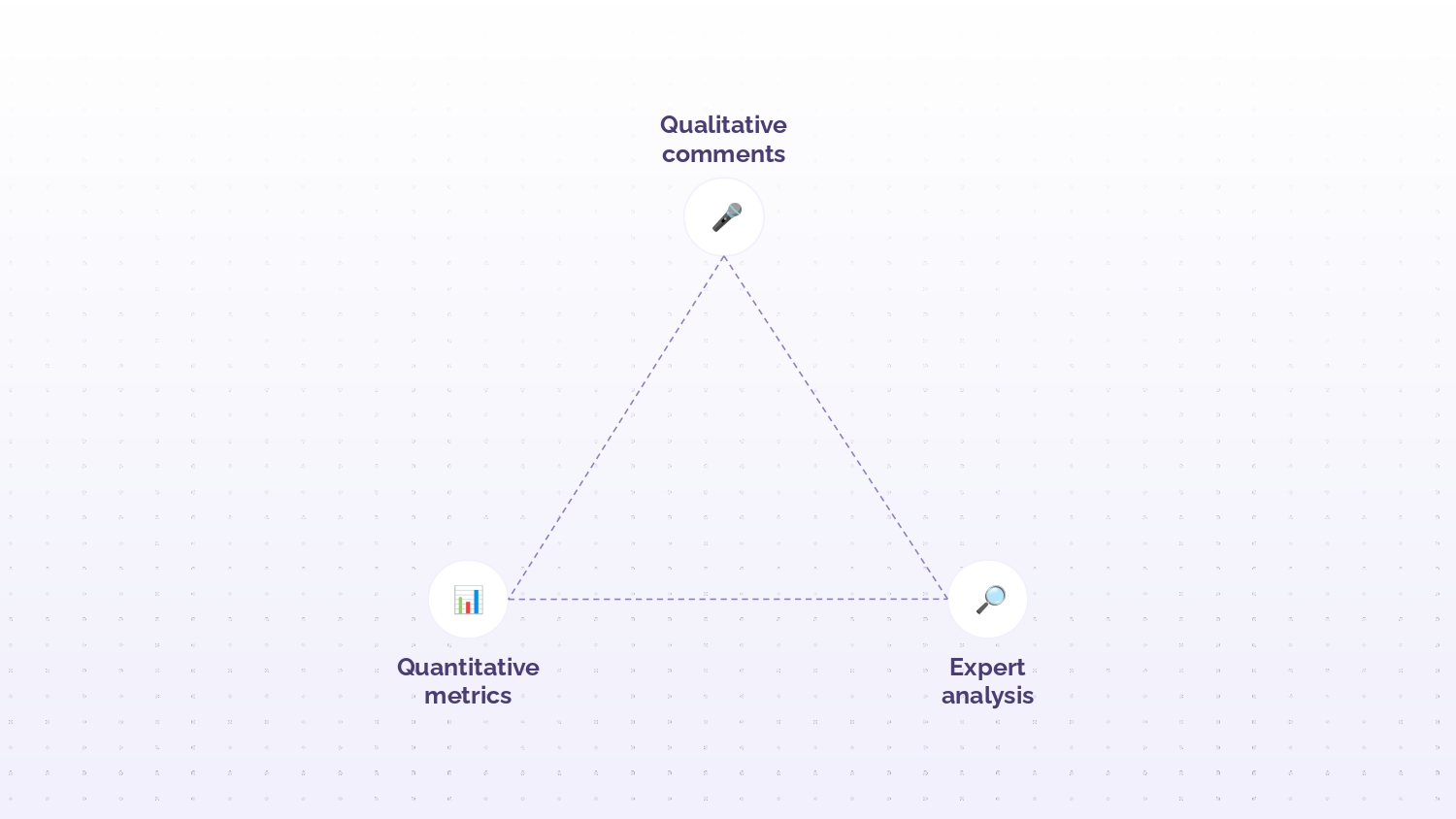
Regular communication with users
Rather than conducting interviews only before a project begins or during an audit, they have become a recurring practice. Regularly testing assumptions against reality ensures that decisions aren’t based solely on data from analytical tools and helps keep us in tune with actual user behavior.
These exchanges reveal what data doesn't always show: misunderstandings, trade-offs made by users, and perceptions of value or trust.
Example: A stable conversion rate can mask deep frustration… which will only become apparent during a qualitative conversation.
Continuous data analysis
Behavioral data remains important, but its role is evolving. Rather than being used for one-off diagnostics, it is becoming a tool for continuous monitoring, enabling the identification of weak signals and triggering investigations.
Monitoring changes in performance, disruptions in workflows, or unexpected behavior allows us to take swift action before minor issues become systemic.
Example: A slight drop in a CTA may seem insignificant, but if it occurs across multiple segments, it may indicate a problem with understanding or positioning.
Quick experiments
Before developing a solution, it is essential to test it. Prototypes, A/B tests, or simplified versions allow you to quickly validate assumptions, reduce product risk, and prioritize efforts based on facts.
This approach not only reduces wasted time and resources, but also fosters a culture of rapid learning where mistakes become opportunities for improvement. The goal is not to be right, but to learn quickly and adapt to users’ actual needs.
How do you implement Continuous Discovery?
Implementing a Continuous Discovery approach relies above all on consistency, collective involvement, and a direct link to decision-making.
Establish a routine
A few user interviews each week, along with constant monitoring of metrics and key points to inform hypotheses, are enough to create a continuous learning cycle. Even with limited resources, this consistent practice transforms research into a true driver of improvement, capable of guiding the product as it evolves
Involve the product team
The Product Trio (PM, Designer, Tech) must be directly involved in Continuous Discovery. It’s not just about sharing insights, but about actively participating in research and testing to ensure that product decisions are truly based on user needs.
In practical terms, this involves:
- Participating in interviews and tests to observe and understand users.
- Joint development of hypotheses and formulation of questions to be tested.
- Regular review of data and observations to adjust the roadmap and prioritize actions.
The designer identifies real needs, the PM links these insights to business objectives, and the tech team assesses feasibility and technical constraints. This collaboration strengthens alignment, speeds up decision-making, and turns shared understanding into actionable steps, transforming every insight into concrete actions.
As Teresa Torres, a product coach and author specializing in Product Discovery, points out, directly involving the Product Trio is a fundamental principle for ensuring that Continuous Discovery becomes a driver of continuous improvement rather than merely a reporting exercise.
Connecting insights and decisions
Every insight should lead to concrete action: testing, prioritizing, and adjusting the roadmap. The shorter and more frequent this cycle is, the more relevant and timely the decisions will be, and the better the team will stay aligned with users’ actual needs.

The goal is not to accumulate insights, but to create a continuous loop between user understanding and decision-making. An observation from a test or interview must be quickly transformed into a hypothesis, and then into a concrete experiment. This approach ensures that insights do not remain theoretical or get lost in deliverables that are rarely reused.
In the most mature teams, research is no longer viewed as a standalone phase of the project but as a continuous feedback loop that directly informs the roadmap and product decisions.
How can you use Assumptions Mapping to figure out what to look for?
With a continuous flow of learning, one question quickly arises: where to start? Not all risks warrant the same level of validation, and not all assumptions are equally critical.
Assumption Mapping is a team exercise in which assumptions regarding desirability, viability, and feasibility are made explicit and prioritized based on their importance and the level of available evidence. It is therefore a practical tool for deciding where to focus research efforts.
The approach is based on a simple question:“What must be true for this idea to work?” The answers are then formulated as hypotheses, beginning with“We believe that…,”covering the four dimensions of product risk: desirability, feasibility, viability, and adaptability.
These hypotheses are then plotted on a cross-tabulation matrix:
- The level of available evidence;
- The potential impact on the product's success.
Critical but poorly validated assumptions then become the priorities for research and experimentation. Assumptions Mapping does not replace user research; rather, it guides it. It helps teams avoid the common pitfall of testing what is safe to test, rather than what is truly risky.
How can I obtain reliable information through the Opportunity Solution Tree?
Once the key hypotheses have been identified, it is still necessary to ensure that the research yields actionable insights rather than mere impressions or confirmation bias.

This is wherethe Opportunity Solution Tree comes in. The process begins with defining a clear and measurable goal, followed by identifying opportunities: the actual problems users face, pain points, or unmet needs. For each opportunity, different solutions are explored and then rapidly tested to verify their effectiveness before being integrated into the product.
This approach makes it possible to:
- Avoid rushing to solutions without understanding the underlying problem
- Structuring the product development process
- Connect users directly to business decisions
The roadmap then becomes a roadmap of opportunities, where each prioritized item is linked to a real user problem and a measurable goal. When used together, Assumptions Mapping and the Opportunity Solution Tree form a coherent framework: the former helps determine what to validate, while the latter structures how to translate these insights into reliable product decisions.
How do you organize your experiments using Experiment Sequence?
Identifying the right hypotheses to test isn’t enough. You also need to test them in the right order, with the right level of effort at the right time.
The concept of the Experiment Sequence, which originates from the book *Testing Business Ideas* by David J. Bland and Alexander Osterwalder, draws directly on the principles of iterative product development. The principle is simple: start with the least expensive experiments and gradually increase the level of investment as hypotheses are confirmed.
A typical workflow might, for example, start with a mock-up to quickly gauge interest in a feature, continue with user interviews to understand motivations and barriers, and then culminate in an A/B test to measure the actual impact on user behavior.
This approach offers two major advantages. First, it avoids the need for massive investment in a solution whose fundamentals have not yet been validated. Second, it fosters a natural progression of confidence: each experiment either reinforces or invalidates previous findings before moving on to the next step.
At Welyft, traditional CRO audits do provide value, but their impact is short-lived. Even a comprehensive report isn’t enough to keep pace with the rapid evolution of digital products.
Our approach is therefore shifting toward a model of continuous impact. User feedback is integrated directly into the product cycle, insights are generated on an ongoing basis, and experiments become a permanent feature.
Today, the goal is no longer to provide a one-off assessment but to drive long-term performance improvements. UX and CRO audits remain useful for sparking discussion or gaining perspective, but they are no longer sufficient in a constantly evolving product environment.
Continuous Discovery helps maintain an up-to-date understanding, reduce product risk, align teams, and continuously improve the user experience. Value is no longer measured by the quantity of insights, but by their ability to be refreshed and put into action over time.
In this context, user research is no longer just a phase of the project; it has become a strategic capability of the organization.


_page-0001.jpg)

_page-0001.jpg)
.png)

.png)
.png)


.png)
.png)
.png)
.svg)
