
.avif)
What is a CRO Audit?
Conversion Rate Optimization (CRO) is emerging as an essential pillar of website strategies.
.webp)
Having traffic is good. Converting it is better. In an ecosystem where customer acquisition cost (CAC) is skyrocketing,conversion rate optimization (CRO) is no longer an option—it's a matter of profitability.
Many companies launch A/B tests at random, based on intuition or generic "best practices." This is a mistake. To unlock your growth, you must first diagnose the problem before prescribing the remedy. That's whatCRO auditing is all about: moving from a "guesswork" approach to a scientific, data-driven strategy.
What is a CRO audit?
A CRO audit is not just a simple "UX checklist." It is a rigorous investigation that combines quantitative and qualitative data to answer a simple question: where and why are you losing money on your website?
The objective is threefold:
- Identify leaks: Identify the stages of the funnel where the drop-off rate is abnormally high.
- Understanding friction: Is it a technical problem? An unclear message? A lack of reassurance?
- Prioritize battles: Determine which pages have the highest potential for immediate gains.
Technical requirements before getting started
An effective audit requires raw material. There is no point in starting if your ecosystem is not ready. Make sure you have:
- Data volume: Ideally, more than 1,000 conversions per month to ensure statistical significance in future tests.
- Tracking integrity: An audit based on false data will lead to false decisions. Verify your tagging plan (GA4 / GTM).
- Technical stability: A slow or buggy website will always convert poorly, regardless of the color of your buttons.
The 4 pillars of the Welyft audit methodology
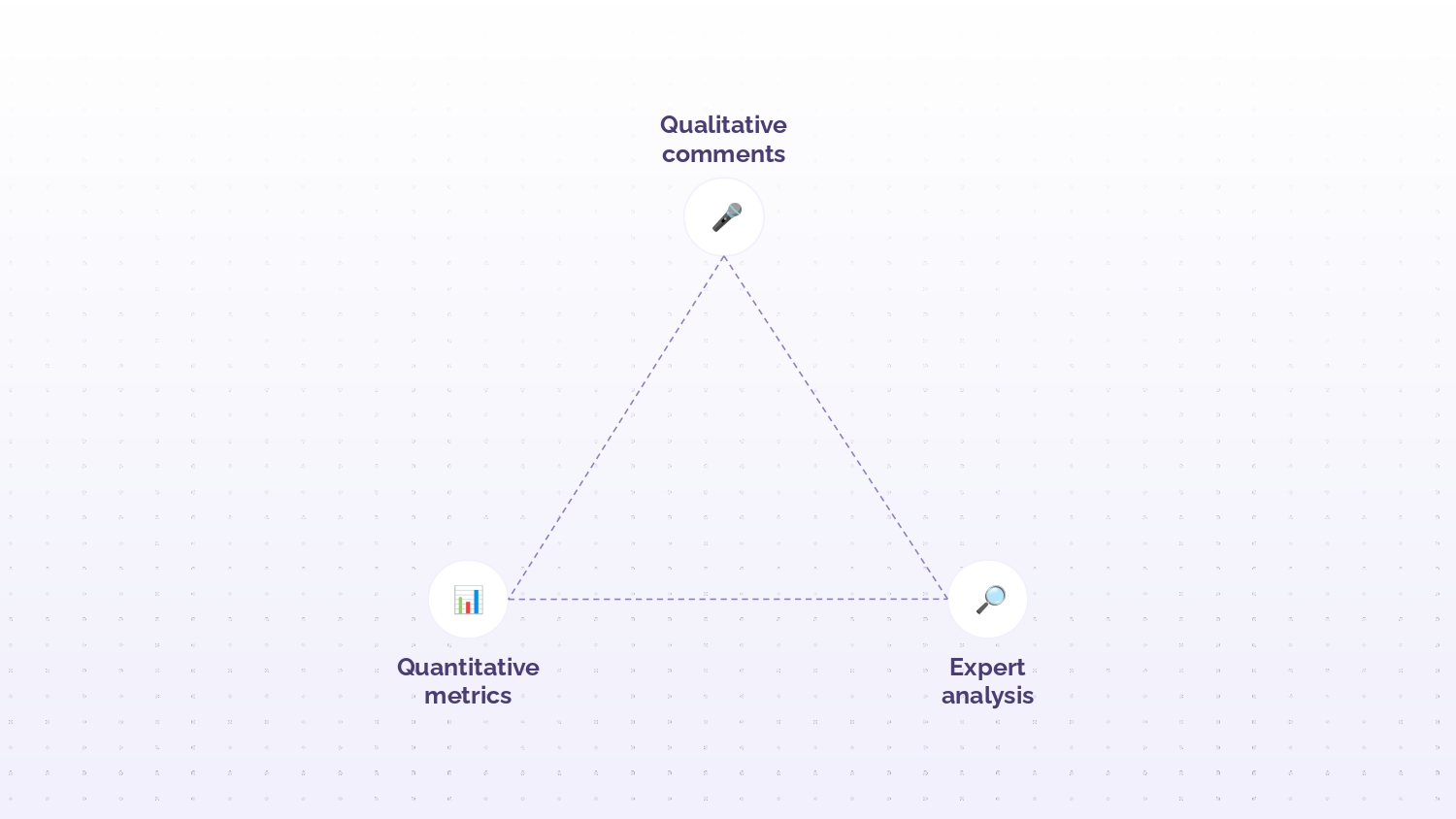
To obtain a 360° view, we don't limit ourselves to Google Analytics. Our methodology combines four sources of truth.
1. Heuristic Analysis (UX Expertise)
We audit the site page by page through the lens of recognized models (such as the LIFT model or Nielsen's heuristics). We evaluate:
- Clarity: Is the value proposition obvious in less than 5 seconds?
- Relevance: Does the content match the user's expectations (Message Match)?
- Friction: What makes the action difficult (long forms, complex navigation)?
- Anxiety: What elements are missing to provide reassurance (social proof, security)?
2. Quantitative analysis (Web Analytics)
It's the "What" and the "Where." Our Data Analytics experts dive into GA4 to segment behaviors.
Concrete example: "We observe that the exit rate on the shopping cart page is 20% higher on mobile than on desktop."
3. Behavioral analysis
Thanks to heatmap and session recording tools (such as Hotjar or ContentSquare), we can observe how users actually navigate the site.
Insight example: "Users are frantically clicking on a non-clickable element" or "No one is scrolling down to the 'Testimonials' section."
4. Qualitative analysis (Voice of the Customer)
Numbers don't tell the whole story. To understand the "why," we use on-site surveys and moderated user tests. Nothing beats feedback from a real person who voices their doubts about your interface.
5 steps to turn auditing into revenue
An audit that ends up in a drawer is useless. Here's how we make it actionable.
Step 1: Data Diagnosis
We isolate underperforming segments (Device, Traffic Source, Browser) to focus the audit on critical areas.
Step 2: Identifying "Low Hanging Fruit"
Some errors do not require testing. A technical bug, a major spelling mistake, or a broken CTA are immediate fixes (Just Do It) that we report instantly.
Step 3: Formulating robust hypotheses
This is the core of CRO agency expertise. We transform a problem into a structured scientific hypothesis:
"Because we have observed [Data], we believe that changing [Element] to [Solution] will have an impact on [KPI] because it plays on the psychological lever [Cognitive Bias]."
Step 4: Prioritization (PIE/ICE Framework)
You can't test everything at once. We score each hypothesis according to the PIE model:
- Potential: What is the expected gain?
- Importance: How much traffic is involved?
- Ease: Is it easy to implement technically?
Step 5: The testing roadmap
The audit results in a clear battle plan: a roadmap of A/B tests to be launched over the next 3 to 6 months to maximize ROI.
The audit is just the beginning
A CRO audit is not an end in itself; it is the starting point for a culture of continuous experimentation. It allows you to move from subjectivity to objectivity and transform your website into a powerful sales machine.
Do you think your website is underperforming but don't know why?
Don't let your visitors leave without buying. Request your CRO pre-audit and identify your first growth drivers.


_page-0001.jpg)
_page-0001.jpg)
_page-0001.jpg)
.png)
.png)
.png)



.png)
.png)
.png)
.svg)
