
.avif)
Best statistical confidence calculators for A/B testing
When it comes to CRO (Conversion Rate Optimization), the reliability of A/B test results is essential for taking the right decisions.
.webp)
In the world of CRO, the worst enemy is not a low conversion rate, but a false positive. Declaring a variant a "winner" when the result is due to chance can be costly: you deploy a feature that brings no return, or even silently damages your business.
MostA/B testing tools (Kameleoon, AB Tasty, VWO) incorporate their own confidence indicators. However, to guarantee absolute neutrality and validate your hypotheses before even launching a test, using a third-party statistical confidence calculator is an essential best practice. But which one should you choose?
How to use a calculator before an A/B test?
A calculator is just a tool. To use it correctly, you need to understand the three factors that influence the reliability of your tests. Without these parameters, no calculation is valid.
1. The MDE (Minimum Detectable Effect)
This is the sensitivity of your test. The MDE answers the question: "What is the smallest impact I want to be able to detect?"
- Low MDE (e.g., 2%): You are looking for marginal gains. This requires enormous traffic (very large sample size).
- High MDE (e.g., 15%): You are looking for radical changes. A smaller sample is sufficient, but you will not see the small gains.
2. Statistical power
Often overlooked, power (usually set at 80%) is your ability to not miss a winner (avoid false negatives). If your power is too low, you could have a winning variant right in front of you without the test declaring it significant.
3. The level of trust
Standardized at 95%, this means that if you repeat the test 100 times, you will get the same result 95 times. Caution: lowering the threshold to 90% to obtain a winner more quickly is a risky practice (known as "P-Hacking").
2026 comparison of the best statistical calculators
We have tested the market standards to help you choose the one that matches your CRO maturity.
1. The Welyft calculator
Designed by our teams for our own agency needs, our tool aims to simplify the scoping phase (pre-test).
🔹 Pros:
- Modern interface: Designed not to intimidate marketers, while maintaining rigor for data analysts.
- Complete view: Simultaneously calculates the estimated duration and sample size required based on your current traffic.
- Pedagogy: Tooltips explain each term to avoid typing errors.
🔻 Cons:
- No module (yet) to calculate significance on Average Order Value (AOV).
2. Convert A/B Calculator
Convert is an A/B testing platform renowned for its privacy management, and their calculator reflects their technical expertise.
🔹 Pros:
- Focus Revenue: It is one of the few that natively manages financial metrics (AOV - Average Order Value, ARPV).
- Anti-Peeking: The tool warns you about the dangers of looking at the results too early.
🔻 Cons:
- A somewhat austere interface (table of figures) that may put off less technical users.
3. Dynamic Yield
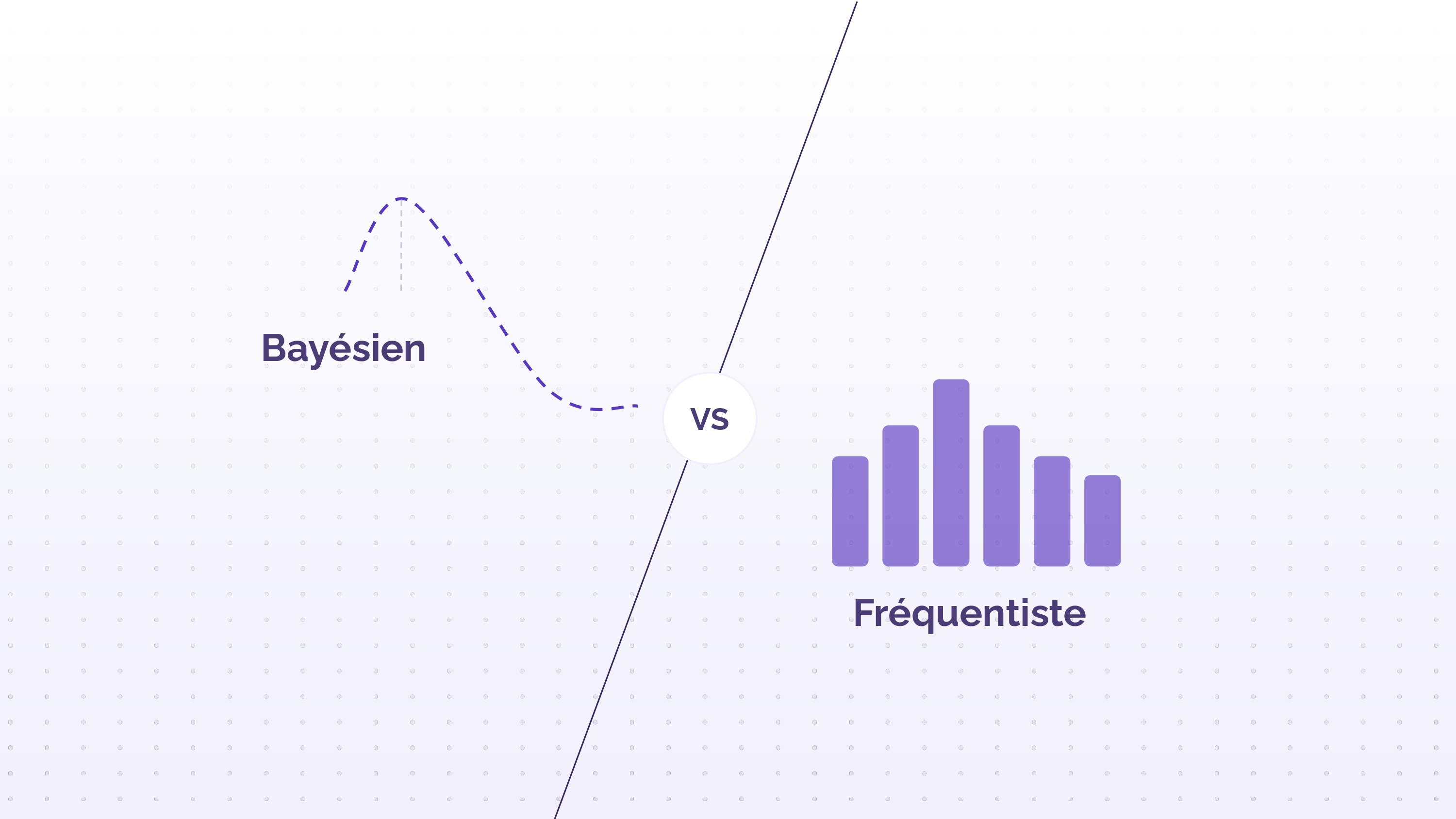
This is a crucial point: most calculators use the Frequentist (True/False) method. Dynamic Yield offers a Bayesian (Probability) approach.
🔹 Pros:
- Agility: The Bayesian approach answers the question "What is the probability that variation B is better than variation A?" (e.g., 85%).
- Easy reading: Less binary than the frequentist approach, this allows business decisions to be made ("I'll take the risk because there's an 80% chance of winning").
🔻 Cons:
- Difficult to compare with the results of your testing tool if it uses a frequentist method (such as Google Optimize at the time or VWO by default).
4. AB Test Guide
A classic used by many consultants for its simplicity.
🔹 Pros:
- Visualization: Bell curves allow you to visualize the overlap between the two variants.
- Simplicity: Ideal for explaining a result to a client or management who does not understand statistics.
🔻 Cons:
- Advanced features are limited.
5. ABTestResult (Evan Miller)
Often considered the mathematical "bible" of A/B testing.
🔹 Pros:
- Comprehensiveness: Handles one-sided and two-sided tests.
- Rigor: This is the tool that offers the most precise control over mathematical parameters.
🔻 Cons:
- "Raw" interface. You need to know exactly what you're doing.
Which one should you choose for your stack?
The choice depends on your profile and your objective:
- To frame a test before launch (Pre-test): Use the Welyft Calculator. It is designed to validate feasibility (Duration/Traffic).
- To analyze revenue (e-commerce): Turn to Convert.
- For quick decisions (Growth): Dynamic Yield 's Bayesian approach is often more actionable.
The tool does not make the expert
Having a calculator does not protect you from interpretation biases. A result that is "95% significant" based on a sample that is too small or a period that is too short (less than a complete purchasing cycle) will still be a false result.
Do you have doubts about the reliability of your data or would you like to audit your experimental protocol?


_page-0001.jpg)

_page-0001.jpg)
_page-0001.jpg)
.png)

.png)
.png)



.png)
.png)
.png)
.svg)
