


This opinion piece comes from our newsletter WETALK every month, get the best insights to optimise your website's experience and performance!
Last month we talked about personalization. We got great feedback and decided to focus today on predictive analytics. It's a fast-growing topic that few companies are yet leveraging in their strategies… Rightly or wrongly?
What is predictive analytics?
The goal of predictive marketing is to answer the question:
"How can I anticipate and address the future needs of my prospects/customers before they even express them?"
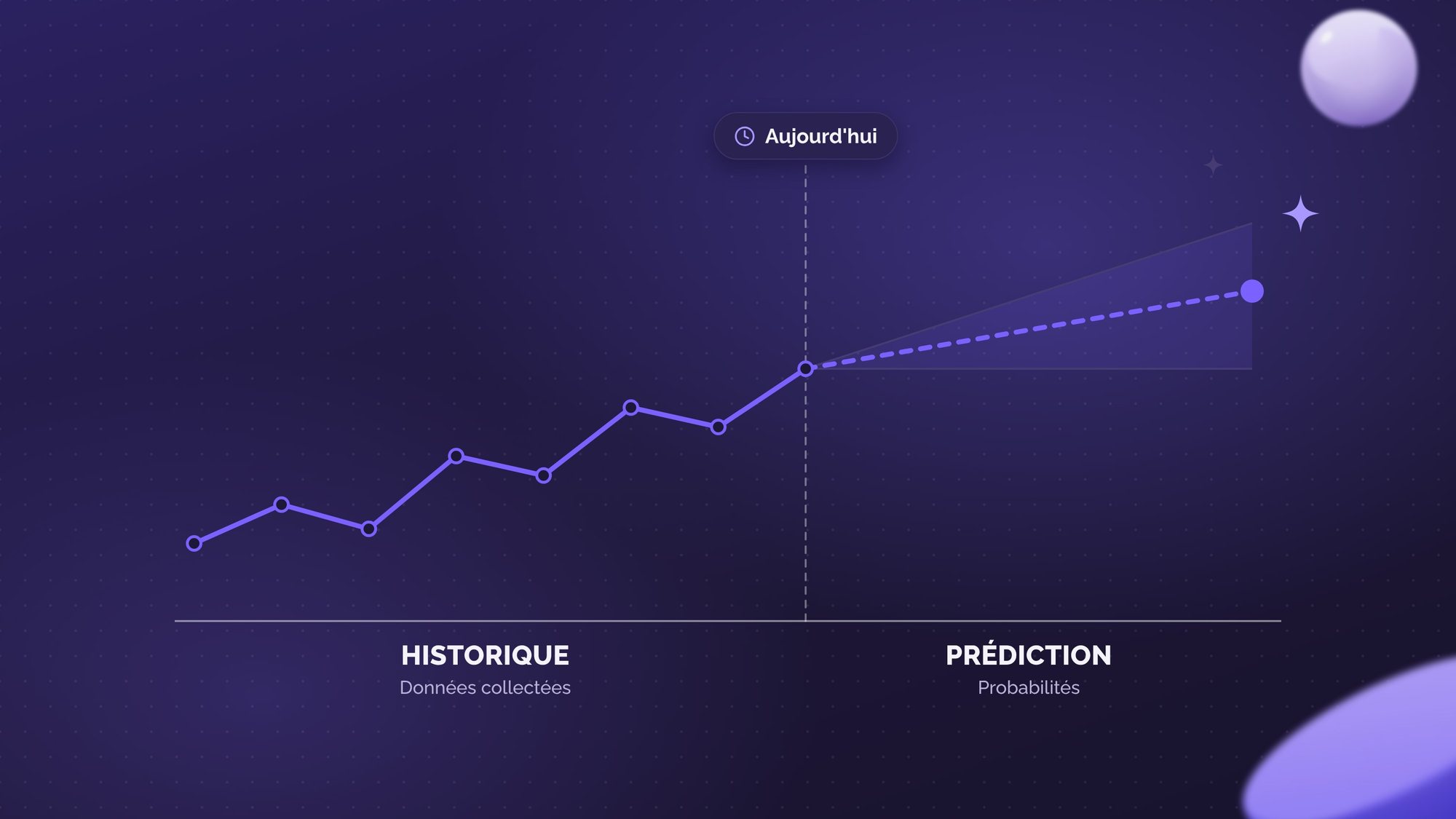
In concrete terms, this encompasses the techniques for processing and modeling customer behavior that make it possible to anticipate their future actions based on present and past behavior.
This approach relies on the exploitation and analysis of a large amount of data… that's the famous "Big Data"! 😊 This data comes from various sources, particularly the company's website.
Predictive marketing allows companies to personalize their offers by presenting the right product or service, at the right time, to the right customer.
No small feat! The days of speaking to all visitors in the same way are long gone, and now the focus must be on a single strategy: delivering a unique customer experience.
Predictive marketing: How to stand out in 2024?
Imagine this: you know exactly which customers are ready to buy and which ones are at risk of leaving your brand. For the former, you send a personalized gift to thank them for their loyalty and encourage them to take action. For the latter, you offer a special promo code to convince them to come back. At the same time, you analyze conversations with your customer service team to spot moments of rising frustration, so you can immediately reassure them with a tailored, personalized response.
That's predictive marketing. It's no longer just about reacting to customers' past behavior, but truly anticipating their future actions and personalizing each interaction accordingly. While this concept isn't new in 2024, the real novelty lies in the democratization of machine learning (ML) tools and large language models (LLMs).
1 - Predictive targeting: identify, anticipate and act:
Once reserved for large companies with specialized technical teams, these technologies are now within reach of all businesses, even those with limited resources. This accessibility allows a growing number of brands to implement effective predictive marketing strategies without needing advanced data science skills.
Solutions like Google Analytics 4 (GA4) and BigQuery ML make this technology accessible to all companies.
You may not know it, but GA4 offers 4 predictive audiences for free. They make it possible to automatically identify users with high purchase potential or those at risk of churning. Media campaigns and onsite targeting can then be adjusted accordingly, for example by offering targeted promotions to at-risk users or personalized offers to potential buyers.
BigQuery ML, for its part, lets you create custom predictive models based on your internal data, for even more refined segments, without having to dive into the complexity of algorithms. These mainstream tools therefore make it possible to leverage predictive segments and proactively adjust your marketing strategies, without requiring machine learning skills.
Among the tools democratizing predictive targeting, we can also mention Emotion AI by AB Tasty, which analyzes users' emotions in real time, adapting messages and offers based on their emotional state. This approach strengthens campaign personalization by optimizing engagement based on visitors' immediate feelings.
2 - Content personalization: understanding and anticipating needs
The second challenge for 2024 that we see in predictive marketing concerns content personalization. Here, it’s not just about knowing when and to whom to send a message, but also how to personalize content in a relevant and contextual way. This is where LLMs (large language models) come into play.
Analyzing emotions and needs with LLMs
LLMs like GPT-4 make it possible to analyze large amounts of text, whether it's customer feedback, conversations with customer service, or even comments on social media. These models are able to identify not only intentions but also the emotions underlying each interaction.
Let's take an example: you analyze the transcripts of customer service interactions to detect signs of frustration or dissatisfaction. From there, you can adjust your recommendations or the tone of your communications to reassure unhappy customers and offer them personalized solutions, thus strengthening their satisfaction and loyalty. At Welyft, we already use these data models to analyze user test transcripts and extract emotional insights that enrich our understanding of journeys.
Hyper-personalized recommendations with conversational agents
Where LLMs particularly shine is in generating truly 1to1 experiences where the user can interact with your brand in a hyper-natural and personalized way.
Thanks to this content-generation capability, LLMs make it possible to create unique customer journeys where each product or content suggestion is based on a deep understanding of the user's needs and emotions. We are no longer simply in behavioral segmentation, but in a complete, real-time understanding of each customer, which maximizes the chances of conversion and retention.
CRO players like Dynamic Yield have looked into this, for example with Shopping Muse, using these models to offer product recommendations that adapt in real time to user preferences.
Technical, strategic and ethical challenges
While predictive marketing offers incredible opportunities, it still faces several challenges that are important to take into account to ensure its effectiveness.
Would you like to learn more about our CRO offerings? Click here
1 - Technical challenges: data quality above all
Data quality is crucial for any predictive model. Without clean, consistent and well-structured data, machine learning algorithms and LLMs will be less effective. You must therefore ensure that your tracking plan is well established, standardized, with clear conventions and rigorous real-time data monitoring. This ensures that the models have accurate information on which to base their predictions.
But be careful, for these predictions to be truly effective, it is essential to have clean and structured data. Tools like GA4 make it easier to collect data in real time, but for their predictive algorithms to work properly, the tracking plan must be rigorously standardized. The naming convention for events and variables must be clear and consistent so that the algorithms can correctly interpret the information. Without a well-defined tracking plan, predictions risk being biased and unreliable.
2 - Strategic challenges: defining clear objectives
Predictive marketing, however powerful, cannot succeed without clear objectives. You need to know what you're trying to optimize: is it your conversion rate? Your customer retention? Churn? Each use case requires a specific strategy and appropriate actions. It's not about using predictions for the sake of it, but about integrating them into an overall vision that meets precise needs.
3 - Ethical challenges: respecting privacy and customer expectations
Finally, a central challenge remains the protection of personal data and respect for privacy. When using predictive technologies that rely on user data, companies must remain transparent about how this information is collected and used. It is essential to comply with regulations such as GDPR and never compromise user trust.
So why is it so complicated?
So we're not talking about witchcraft, but too few brands work on these challenges. It's a real challenge that can be complex to implement without resources and skills.
Some tools help fill this gap and can be very useful, but the lack of resources can still be felt.
It's one of our favorite recommendations: start small before scaling up by structuring yourself. This advice is especially valid for predictive marketing, where the first milestones are essential!
Are you working on these projects in your company? Don't hesitate to contact me, I'd love to be able to talk about it with you!