

This opinion piece comes from our newsletter WETALK every month, get the best insights to optimise your website's experience and performance!
For many years, we have worked with dozens (hundreds) of brands to support them on their CRO challenges.
My observation is often the same: the success of a CRO program and the results that follow are often linked to 2 points:
- The maturity of the organization.
- The organization of the teams.
As you'll have understood, today we're going to focus on point 2!
Yes, CRO has changed!
(A little thought for all those who still sell CRO as a miracle recipe that would allow you to earn millions in revenue by adding up the projected uplifts of A/B tests…🔫)
It was an obvious entry point back when brands were investing without limit in acquisition and when only the ROI of media campaigns and the conversion rate mattered.
But fortunately, practices have evolved and we've been able to gain some perspective!
Because yes, CRO has changed!
When I started doing CRO, we mainly talked about A/B testing, on the web, focusing on conversion. That was CRO:
- Doing a data, UX audit,
- Building a prioritized roadmap
- Launching A/B tests, preferably winning ones, to show the value of the program.
However, the ecosystem has greatly matured, and so have the practices.
These short-term strategies that put CRO in the spotlight in France no longer meet the challenges brands face.
Today, we talk much more about discovery, experimentation, and this goes far beyond simply changing the color of a CTA. The KPIs are more global; we no longer talk only about conversions, but also engagement, cLTV, churn rate, % revisit, NPS, etc…
Tools are also becoming more global, and clearly that changes everything since use cases now involve different teams (CRO, CRM, Content, Acquisition, IT department…). These experiments are also on app, and multi-channel.
In short, we've moved from a “basic” approach to one that takes a step back and, moreover, gets closer to product teams! We now seek to enter into a “de-risking” mechanic, using data, benchmarks, A/B tests, user interviews…
It therefore becomes imperative to rethink the organization so that it meets these challenges, and this largely involves a new vision and a new positioning of CRO teams.
So we isolated an essential question, notably related to product teams:
“What organization allows for merging the two roadmaps and thus ensuring the impact of CRO on the product?”

So, looking at this image 👆, do you think it's more with a classic CRO approach or a product experimentation approach?
Yes yes, it's a rhetorical question 🫣
So, what is the ideal organization?
Unfortunately, there is no ready-made answer, and part of our work with our clients actually consists of working on these very topics:
- During our CRO support engagements, by working to evolve the various processes and the links between teams.
- During specific missions dedicated to the CRO org.
With our experience, we have nonetheless identified 3 main organizational formats that we can see on the market:

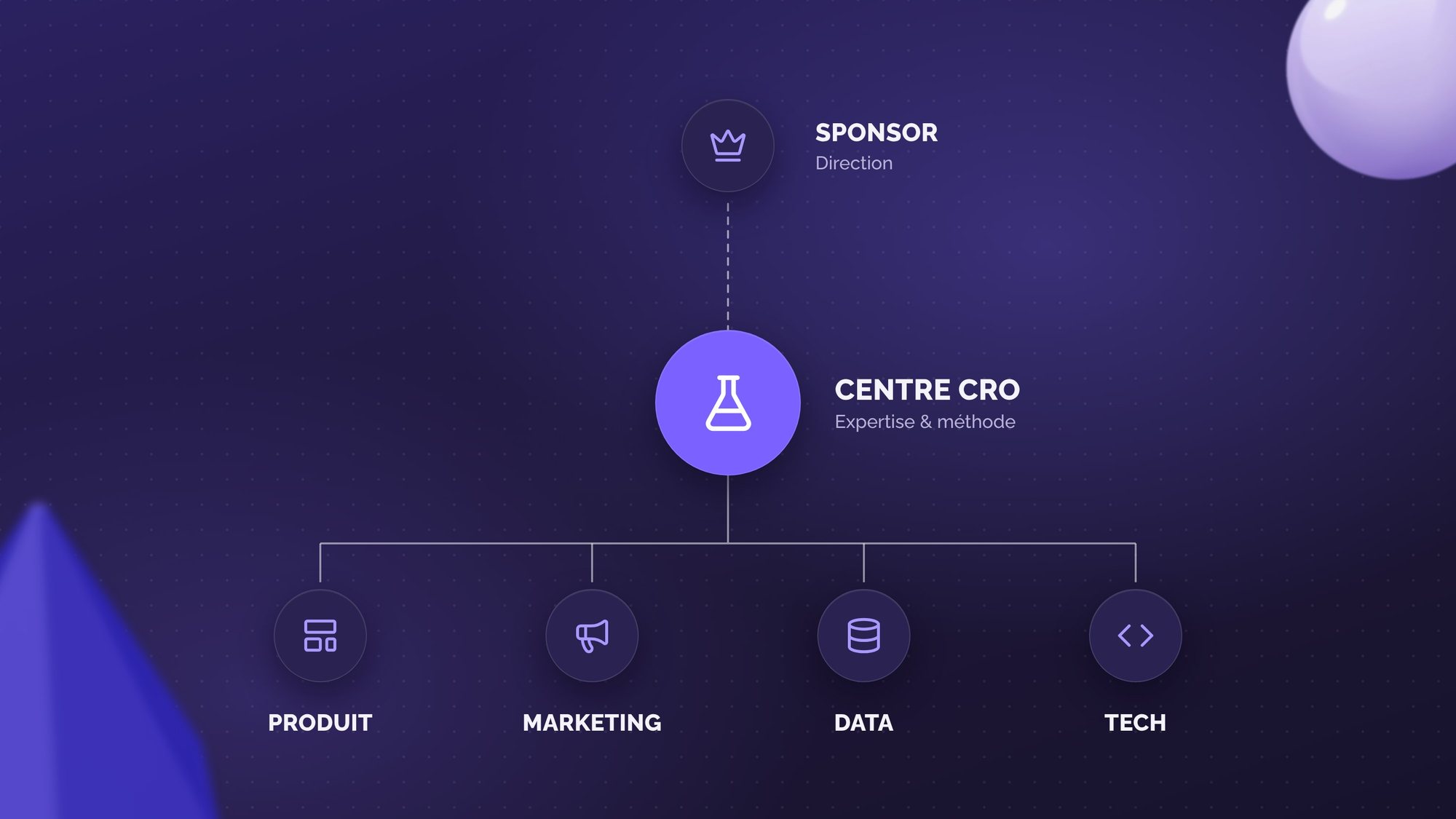
- The Coaching format
- The Squad format
- The Team format
As you can see, each format has its advantages and disadvantages. We've done the work of evaluating the pros and cons, but if you'd like to discuss it in more detail, don't hesitate to contact me 😉
To give you some perspective, a large majority of the brands we meet are in a "team format". This format, while effective, now shows many limitations, and our work generally consists of helping our clients evolve toward "coaching" or "squad" formats.
This is work that takes time (several months / years); alignment needs to happen between the different teams, particularly to align methodologies and objectives. You need to understand everyone's stakes and how it's possible to coordinate this.
What do we have to gain and why is it essential?
By aligning teams around a shared vision, brands can maximize the impact of their optimization strategies. This translates not only into improved conversion rates, but also into better customer loyalty and retention. Why? Simply because the user experience is at the heart of the concerns!
By moving from a more standard model with an isolated CRO team to a more integrated and collaborative approach, brands are able to "de-risk" their investments in product and innovation. This means making more informed decisions based on data and experimentation results, which reduces costly failures and increases efficiency 🚀
It's also an excellent way to align all teams toward a common goal. (PM, PO, CRO, UX/UI, UXR, Dev…)
Finally, in a constantly evolving competitive environment, being able to quickly adapt to new trends and consumer expectations is crucial. A flexible, well-structured CRO organization will react much more quickly to market changes.
In my view, optimizing the organization of CRO teams is not a simple option, but a necessity for any company wishing to sustain its growth and maintain its position as a leader! (Or become one 😇)
Conclusion:
As you'll have understood, we believe this transformation can have a significant impact for brands. It's a strategic approach that allows companies to position themselves competitively in an increasingly complex and demanding digital landscape. By integrating approaches like the coaching format or the squad format, brands can open themselves up to new growth opportunities.
Be careful, this isn't work that happens overnight! Above all, it's essential to have an internal c-level sponsor who will champion the project, and you'll need to take your time, moving forward step by step to build the organization that matches your challenges.
By developing an overall culture of experimentation, brands are preparing for a future where continuous improvement is not an end goal, but a process that evolves to meet users' needs with the greatest possible precision.
Do you have questions or want to explore the topic further? Don't hesitate to contact us to discuss it and explore together the best approach for your organization, or discover our offers here