


For a long time, SEO came down to a relatively simple equation: clean code, well-chosen keywords, quality backlinks. Today, Google has access to a large number of behavioral signals to assess the real quality of a page. It no longer just reads your content, it observes how users behave once they arrive on your site.
We often talk about Core Web Vitals (LCP, INP, CLS) as the bridge between UX and SEO, but it's much more than that. Behavioral signals are more discreet and yet just as decisive.
But rest assured, Google has just published (May 2026) its official documentation on optimization for generative search, and the message is unambiguous. SEO fundamentals remain fully valid, and user experience is one of its pillars.
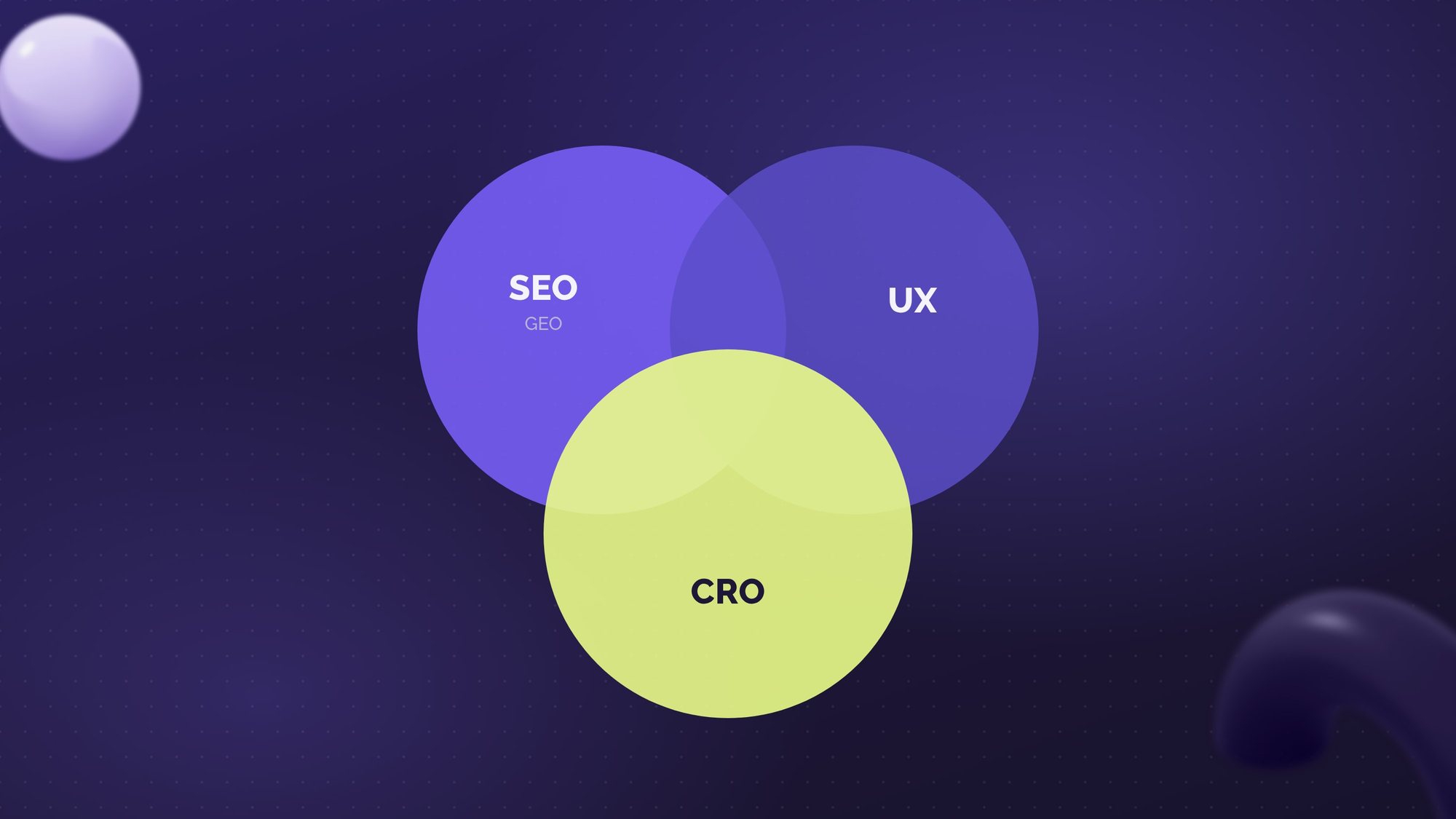
More than ever, SEO and UX move forward together. It's even become self-evident in our day-to-day work. On every redesign, every CRO engagement, we work hand in hand with our clients' SEO teams. And that's a good thing, because there was a time when the slightest block placement would trigger endless debates.
Pogo-sticking, the first post-click signal
Bounce rate, this indicator that measures the percentage of visitors who leave a site without interacting, is often misunderstood. A high bounce rate is not systematically negative. For example, a blog post read in full and then closed can show a 100% bounce rate while having fully satisfied the user.
What interests Google more is pogo-sticking. This behavior where a user clicks on your result from the SERPs, immediately returns to Google, and clicks on a competing result. This signal clearly indicates that your page did not meet the request.
If a user returns to Google less than 10 seconds after clicking on your result, this is interpreted as a relevance failure. Repeated at scale, this behavior pushes down your rankings even if your content is technically optimized.
Information architecture and time spent on the page
Your site's architecture is one of the most underestimated UX signals in SEO. Clear navigation doesn't just serve the user, it also guides crawl bots, facilitates PageRank distribution, and signals the site's editorial logic to the algorithm.
But beyond crawling, it's the navigation experience that matters. A user lost in an overly deep hierarchy, unable to find what they're looking for in 3 clicks or less, is a user who leaves. And a user who leaves is a negative behavioral signal.
The 3-click rule isn't a UX designer myth, it's a measure of friction.
Moreover, Google doesn't officially tell you that it measures time spent on your pages, but the patents filed by Alphabet and the correlations observed by SEOs around the world tell a different story. Dwell Time, the duration between clicking on a result and returning to the SERPs, is an implicit indicator of satisfaction.
Content that holds attention for 4 or 5 minutes sends a strong signal. Conversely, a Dwell Time of 15 seconds on an article supposed to be comprehensive is an anomaly that the algorithm registers.
Scroll depth completes this picture. A page where 80% of users don't go beyond the first third of the content raises a simple question: does this content really deserve its length? A page that is too long, poorly structured, or whose value is concentrated at the end will be penalized behaviorally before being penalized algorithmically.
Connect your site to Contentsquare, for example, to visualize your scroll heatmaps.
Readability and visual hierarchy of content
With the rise of natural language processing models, Google is increasingly able to assess the structural quality of a page, not just what it says but how it says it.
A wall of text with no breathing room, no subheadings, no visual elements, is a painful reading experience and Google knows it. The readability of content is correlated with its engagement rate, the more readable it is, the more users stay, scroll and interact.
This point is explicitly addressed in Google's official documentation on generative AI. The company notes that users "appreciate when pages are organized into paragraphs and sections, with headings that clearly structure the reading experience". In other words, what you do for your readers, you also do for the systems that decide which pages deserve to be cited.
According to Nielsen Norman Group data, users read on average 20 to 28% of a web page's content. Well-structured content is not designed to be read in full, it is designed to be scanned efficiently, with perceptible value at every level of reading.
Understanding search intent
An internet user doesn't type a keyword, they express a concrete need. Two queries that appear similar can hide radically different intentions. "running shoes" and "best running shoes for marathon" do not call for the same page, the same content, or the same user experience.
Analyzing search intent involves classifying these queries into four main categories:
- Informational: the user seeks to understand or learn ("how does CRO work"). They expect educational, structured content.
- Navigational: the user is looking for a specific brand or site ("Welyft CRO agency"). The site is typically positioned as the first result.
- Commercial: the user compares before buying ("best CRO agency Paris"). They are receptive to reviews, comparisons, social proof.
- Transactional: the user is ready to act ("CRO audit"). They expect a clear CTA, an accessible form, an immediate promise.
Each intent category calls for a specific UX experience. Ignoring this distinction exposes your page to a mismatch between what the user is looking for and what they find, in other words, to pogo-sticking.
Analyzing search intent doesn't stop at classification. The search volume associated with each query provides valuable insight into the very nature of these intentions and helps assess demand.
Added to these fundamentals today is a new paradigm: the shift toward conversational queries driven by the use of LLMs or generative AI. With the adoption of these tools, internet users are getting used to formulating much longer, richer and more contextual requests. These queries, which could be described as "ultra long-tail", demand content that is not only relevant but capable of addressing multiple ultra-personalized criteria within a single page.
Web performance as a behavioral signal
Core Web Vitals are often presented as purely technical metrics, but their real impact on SEO is above all behavioral.
A too-slow LCP means a user who waits. And a user who waits is a user who leaves before even seeing your content. Pogo-sticking can therefore be triggered not because your page is poorly designed or poorly targeted but simply because it takes too long to load. Google doesn't distinguish between the two, it records a quick return to the SERPs and interprets it as a failure.
CLS, those visual shifts that make content jump around during loading, generates another type of friction. The user clicks in the wrong place, loses track, feels lost. This disengagement shows up directly in scroll depth and time-on-page metrics.
Web performance is therefore not an end in itself. It determines your page's ability to produce positive behavioral signals, and without it, even the best content, the best structure and the best targeting cannot reach their full potential.
A page that is slow or visually unstable never gives UX a chance. It's the first layer to fix before optimizing anything else.
How does UX improve your GEO?
The rise of answer engines (ChatGPT, Claude, Gemini, etc.) has given birth to a new paradigm: GEO (Generative Engine Optimization). The goal is no longer just to appear in traditional search results but to be cited and recommended by generative AI models.
GEO doesn't start from scratch. It is largely built on the same foundations as SEO and, by extension, on the quality of the user experience you provide.
This is precisely the official position adopted by Google through its May 2026 publication on optimizing for generative search. The engine states in black and white that "optimizing for generative search is optimizing for search in general, and therefore doing SEO". The reason is clear: AI Overviews and Google's AI mode rely on the same index and the same ranking systems as traditional search. When AI builds an answer, it draws from pages that are already well positioned organically, meaning those that produce the best behavioral signals. Good UX therefore directly fuels your visibility in generated answers.
Google even goes further, debunking in passing most of the "GEO hacks" circulating out there: no need for an llms.txt file, no need to break your content into micro-blocks for AI, no need to rewrite your pages in a special language. What matters is unique content, organized for humans, on a page that offers a good experience.
Well-structured, hierarchized, readable content that is perfectly aligned with search intent is precisely the type of content AI models favor when formulating their answers. These models are trained to identify clear, authoritative, and easy-to-interpret sources — exactly what good UX produces.
However, note that this clarification only applies to Google. For other LLMs (ChatGPT, Claude, Perplexity, Mistral, etc.), we still have no equivalent official documentation on their criteria for selecting sources. Each relies on its own retrieval mechanisms, and these logics are constantly evolving without public communication.
UX is no longer an SEO option, it's a ranking factor
For a long time, these two worlds tended to be seen as opposites. Personally, when I was an SEO consultant, I experienced firsthand the sometimes tense debates between SEO and UX teams. I (on the SEO side) would recommend more contextual links on a page to distribute internal popularity with optimized anchors. On the other side, UX wanted to focus the user's attention and avoid exit points. We each had our arguments, and in hindsight, we were both right.
Today, this debate no longer really makes sense. Teams need to work hand in hand, and trade-offs are made around a single priority → the user.
This is precisely why, at Welyft, the SEO dimension is integrated from day one into all our redesign and optimization work. Thanks to my SEO/GEO background, this bridge happens quite naturally. We no longer work in silos; we design UX experiences that are fully aligned with search engine requirements.
The goal is twofold: avoid dramatic ranking losses causing a drop in traffic at launch, but above all, design a site that is natively "SEO and UX friendly" and will perform over the long term.
Because UX designed first and foremost for the customer means stronger behavioral signals, better organic positioning, and, ultimately, measurable growth.
And if you'd like to talk about it, don't hesitate to contact me directly. This topic particularly interests me, and I'm always happy to discuss a specific case, whether it's about SEO, UX, or both.