


Since the Digital Markets Act (DMA) came into force in March 2024, the rules of digital advertising in Europe have changed. While GDPR (2018) focused on privacy protection, the DMA aims to break up the monopolies of digital giants.
For marketing managers, the equation is simple: without technical compliance, remarketing and similar audiences on Google come to an end. This article breaks down the real impact of the DMA on your marketing stack and how Consent Mode V2 has become the only key to maintaining your acquisition performance.
Why is your ecosystem impacted by the DMA?
The Digital Markets Act doesn't directly target advertisers, but "Gatekeepers". These are the systemic platforms that structure the web: Alphabet (Google), Meta (Facebook/Instagram), Amazon, Apple, Microsoft and ByteDance (TikTok).
To avoid colossal fines (up to 10% of their global revenue), these players must now prove to the European Commission that they have obtained explicit user consent to cross-reference their data.
The domino effect on advertisers
This is where you come in. Google can no longer simply assume consent. It now requires you, the advertiser, to send it a technical "signal" proving that the user said "yes".
The direct consequence: If you don't send this signal via Consent Mode V2, Google cuts off access to targeting features (Remarketing, Customer Match) and degrades the accuracy of your tracking.
What is Google Consent Mode V2?
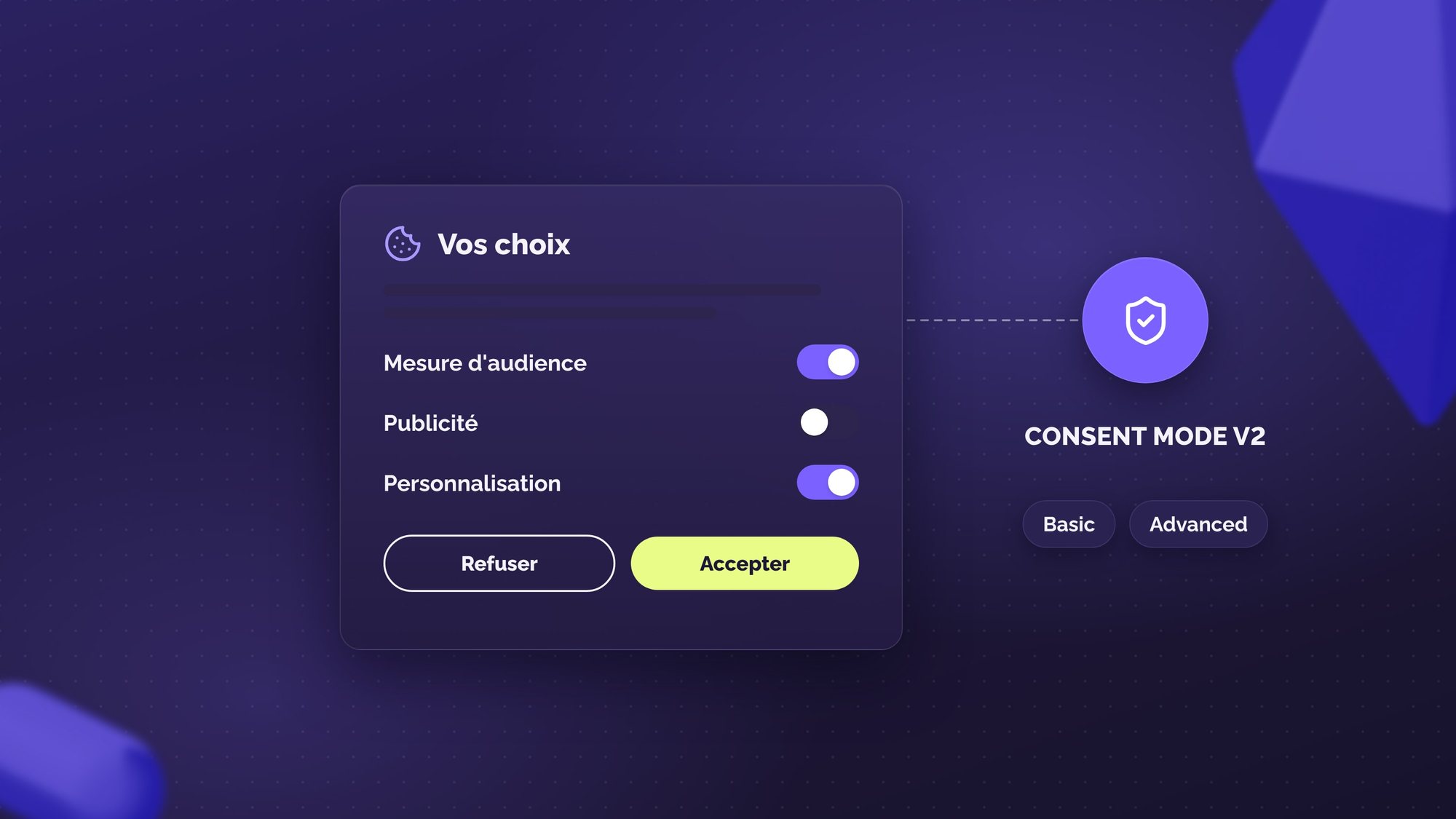
Consent Mode is the protocol that allows your site to communicate your users' consent status to Google tags (Google Ads, GA4, Floodlight).
Version V2 introduces two new critical parameters that are added to the existing ones (analytics_storage and ad_storage):
- ad_user_data: Does the user agree to their data being sent to Google for advertising purposes?
- ad_personalization: Does the user agree to remarketing (personalized advertising)?
Without these two green lights, the advertising "pipes" close automatically.
Which collection strategy should you choose?
The implementation of Consent Mode V2 offers two levels of granularity. The choice depends on your risk appetite and your data needs.
Option 1: "Basic" Consent Mode (Maximum security)
This is the strict approach. If the user refuses cookies:
- No Google tag fires.
- No data is sent.
- Consequence: You lose 100% of visibility on users who did not consent (often 30 to 40% of traffic).
Option 2: "Advanced" Consent Mode (Performance & Modeling)
This is the recommended approach for maximizing data. If the user refuses cookies:
- Google tags fire in "restricted" mode.
- They send anonymous "pings" (no cookies, no personal identifiers).
- The benefit: Google uses these pings to model conversions. You thus recover a statistical view of performance, filling the gaps in your GA4 and Google Ads reports.
How does Welyft secure your compliance and your data?
Implementing Consent Mode V2 is not just a box to tick, it's a surgical intervention on your tagging plan. As a Data Analytics agency, we deploy a rigorous methodology:
1. CMP (Consent Management Platform) Audit
We check whether your cookie banner (Cookiebot, Didomi, Axeptio, OneTrust...) is technically capable of capturing and transmitting the new `ad_user_data` and `ad_personalization` signals.
2. Google Tag Manager (GTM) Configuration
We reconfigure your tags to listen to the CMP's signals.
- Activation of "Consent Overview" in GTM.
- Updating triggers to comply with Basic or Advanced logic.
- Verification of the triggering order to prevent data leaks before consent.
3. Testing & Validation
We use "Preview" mode and the developer console to ensure pings are correctly sent (`gcs` and `gcd` status) and that remarketing is indeed active for consenting users.
Turn the constraint into an opportunity
DMA and Consent Mode V2 are not optional. Failing to comply means accepting to run your acquisition campaigns blindly and depriving yourself of Google's powerful bidding algorithms.
By switching to Advanced mode with a clean implementation, you can recover up to 70% of lost conversions through modeling. This is a major competitive advantage over poorly configured competitors.
Not sure about your current configuration? Are your Google Ads audiences shrinking? Request a Consent Mode compliance audit from our data experts.