


This post is from our newsletter WETALK every end of month, receive the best news to optimize your website's experience and performance!
🚀 Our 3 steps to structure a personalization use case.
When starting out on this topic, there is a tendency, in order to move quickly, to launch off-the-shelf use cases offered by the A/B testing tool or to copy a competitor without any real thought on the actual needs of users.
At Welyft, when we design a personalization strategy, we use a structured framework that brings together all the elements needed to design use cases. This approach allows us to optimize the success of use cases by focusing our thinking on a single objective: being genuinely useful to users.
By putting usefulness at the core, you will maximize the perception of relevance, simplicity, effectiveness, adaptability, as well as the quality of support of your customer experience. These elements will drive your customers' loyalty and, ultimately, incremental revenue.
This framework is not a miracle solution for all organizations, but I hope it will help you ask the right questions if you wish to invest in this topic.

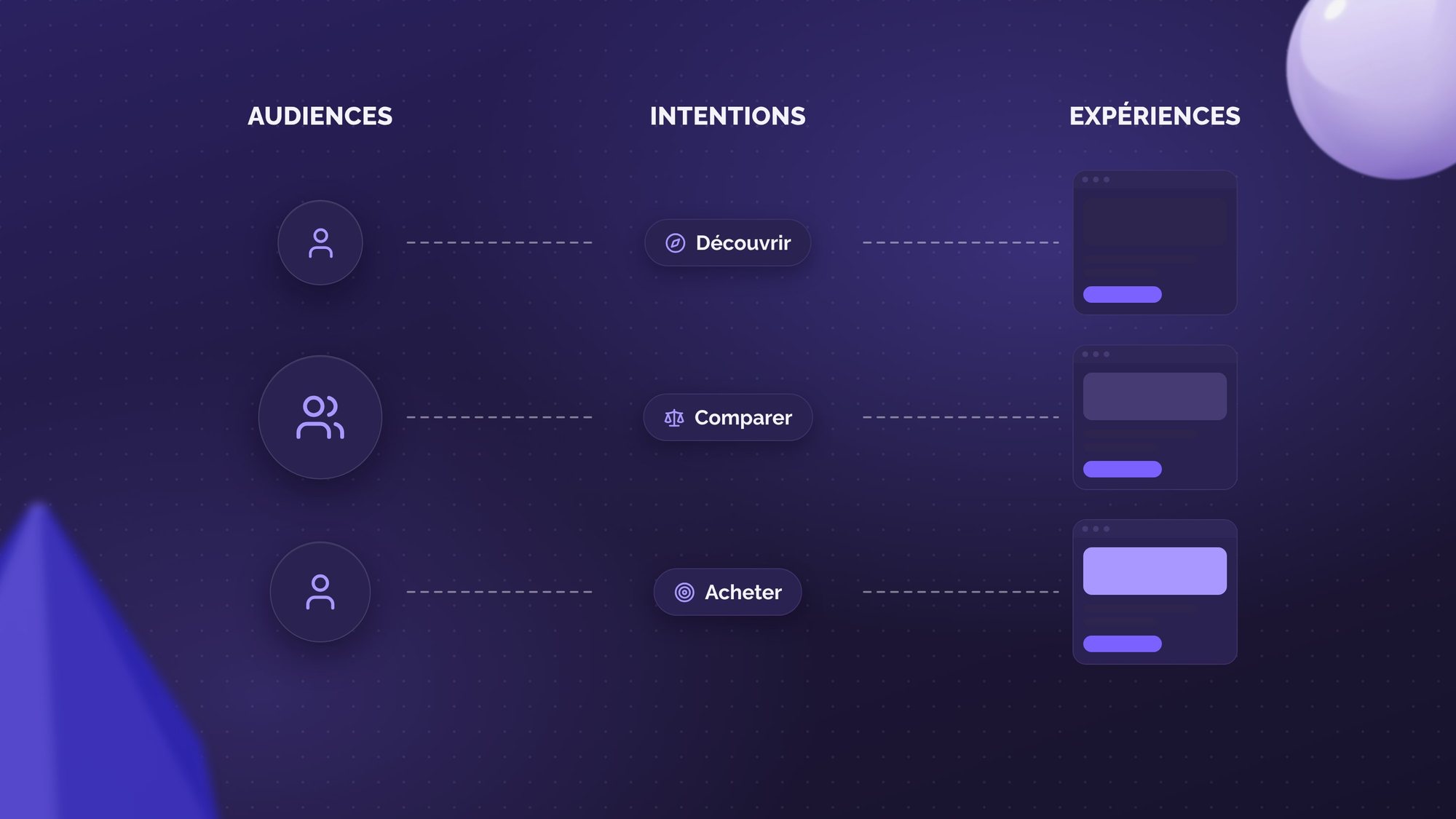
The goal here is both to quantify your audiences to ensure sufficient reach and ROI, and also to group them by interests and intentions in order to associate them with relevant activations/messages/products and boost their journeys.

A user research effort must precede this scoping phase in order to provide all the insights necessary for building the experience.
To maximize success, here are our two tips:
- We recommend converging on a single format to which several audiences, triggers, and messages can be assigned, in order to validate the value of the message during the first testing phase.
- Start with use cases that have the maximum reach with the minimum complexity. While interest groups (CRM segment, affinity, etc.) can be useful to contextualize expectations, conversion funnel audiences (anonymous, suspect, prospect, customer) are an ideal segmentation to start identifying the segment's intentions.

Mapping the skeleton of the use case will enable it to be scaled; the goal is to prepare the testing plan and the different combinations between messages and audiences that we will aim to target.
This does not mean that all scenarios need to be tested, but it will help identify opportunities to be useful to users and validate the overall consistency of the journey.
To conclude:
To avoid generating disappointment during implementation, personalization use cases must follow a clear framework and be centered on data, on “best in class” practices, but above all on user needs or “pains.” (And therefore not be based 100% on assumptions.)
This short framework will allow you to scale your approach by prioritizing the experiences that reach the most people and are the most relevant.
The greater the number of combinations, the more impactful the case can be, but this will mechanically increase its complexity (less is more). Scenarios should be prioritized based on impact, visibility, and complexity in order to maximize ROI.
Our priority should shift from personalization for the sake of personalization, to creating real added value for the customer. The question that should drive us: How can we be more useful to our users?
Curious to know how this works in your organization, feel free to contact me to discuss it, or discover our offers here