


You've done your analysis and ideation work properly: you've talked to your customers, dissected your data, exchanged insights with different departments. In short, you've identified a series of journeys to optimize, features to test, in other words dozens and dozens of hypotheses to validate. Now you have to face the reality of experimentation: not everything can be tested. Lack of traffic, development resources, design or analysis capacity, resistance from other teams—there's no shortage of reasons to postpone a test. And yet, on top of all these very real obstacles, you could make your life even more complicated by adding an extra constraint: running only one test at a time, in the name of a supposed statistical purity that would make a textbook blush, but would leave most practitioners pale.
This "one test at a time" principle, originally designed to protect the reliability of results, is in reality the main brake on your product velocity: weeks of waiting for you and your teams while your competitors move forward. In your organization, innovation waits in line.
And yet, industry leaders solved this problem long ago, and their approach is more accessible than you might think. Do you think the "usual suspects" of digital growth—Google, Meta, Netflix, Spotify, BlaBlaCar, Leboncoin—run hundreds, sometimes thousands of tests simultaneously by going one at a time? Of course not. Sure, these giants have extraordinary resources, but that's not what explains these volumes: when you factor in the teams running these tests, you realize the lever is methodological, not budgetary. All the more so since some of them, Google or Netflix for example, have fewer page templates than an e-commerce site. Each page must necessarily carry several experiments at the same time, since Google Search can only optimize the search results page. The "one at a time" rule is no longer a best practice. It's a competitive handicap.
The question is no longer whether you should run your tests in parallel. It's how to do it without compromising your data or your product.
1. Velocity vs. Fear of collisions
The business reality
While an isolated test is statistically desirable, it is operationally paralyzing. Every week spent waiting for one test to finish before launching another is a week of learning lost. At scale, this translates into months of delayed decisions and missed revenue.
Let's take a concrete case. A product team with a backlog of 50 hypotheses and an average cycle of three weeks per test can only validate 17 hypotheses per year in sequential mode. The same team, with the right safeguards, can handle four to five times more by parallelizing—that is, the entire backlog and the resulting iterations. The gap is not marginal: extrapolating from a 60% learning rate, a third of which are winning tests, parallelization would generate 30 additional insights, including 10 additional winning tests and 20 avoided losses, potentially doubling or even tripling the ROI of an experimentation program.
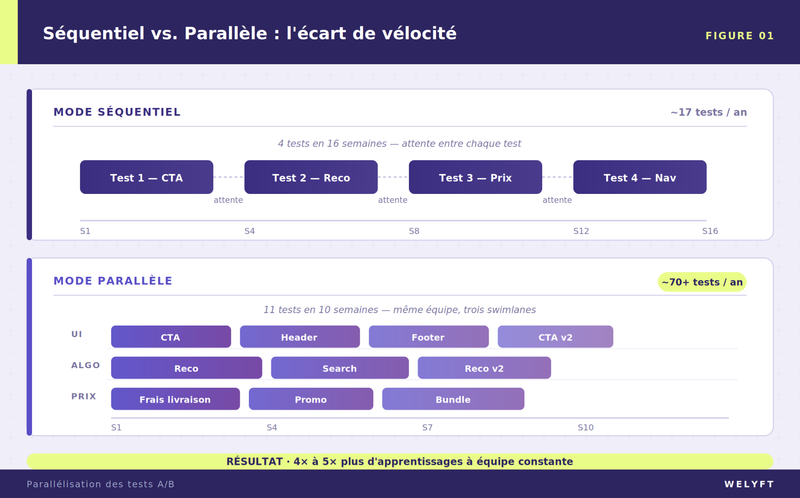
Figure 1: modeling of velocity gaps between a sequential and a parallelized roadmap
And this gap widens over time. Teams that test faster learn faster. Those that learn faster iterate faster. And those that iterate faster capture a disproportionate share of value in their market. This isn't theoretical: it's a compounding effect observed in every digital leader that has made parallel testing a standard practice.
Why isolate? The fear of interaction effects
Let's be clear: interaction effects do exist. If you test a red button and a red background at the same time, you risk making your interface unreadable for part of your audience and invalidating both tests. This type of direct conflict between two tests, known as antagonistic interactions, can lead to degraded user experiences and product decisions based on flawed data.
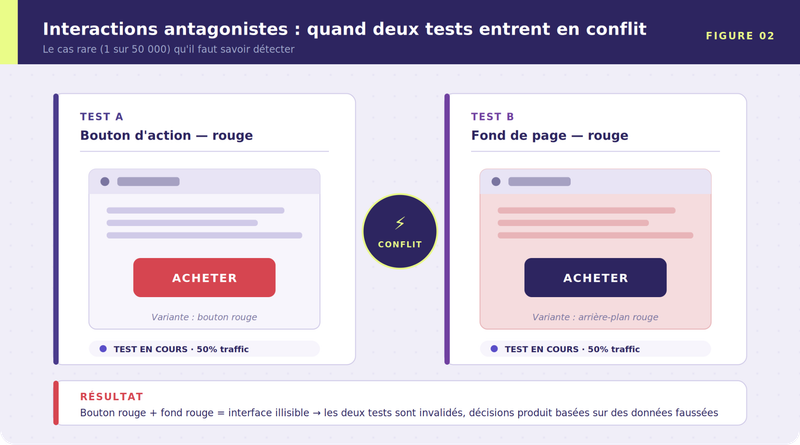
Figure 2: illustration of antagonistic interactions between two parallelized tests on the same element
But the reality is that the vast majority of interactions between tests are nonexistent, and even fewer are significant. A study conducted by Microsoft's experimentation team (Kohavi et al.), analyzing hundreds of thousands of pairs of simultaneous tests on Bing and Microsoft products, demonstrated that interactions significant enough to distort a production decision occur only in 1 case out of 50,000.
One in fifty thousand.
This rarity is easily explained: it's already rare to detect a statistically significant effect when a test runs alone (Spotify shares learning rates of 64%). It is therefore even less common for two tests to simultaneously produce a significant result, and rarer still for this phenomenon to reverse a production decision. That said, in the rare cases where strong interactions do exist and go unmonitored, the probability of choosing the wrong variant can climb to about a third of cases.
The answer is therefore not blind trust. It's implementing an architecture and governance that orchestrate this parallelization in order to detect interactions when they occur and to learn from them.
2. How to parallelize like the most reputable CRO programs?
Layered architecture: a roadmap with swimlanes
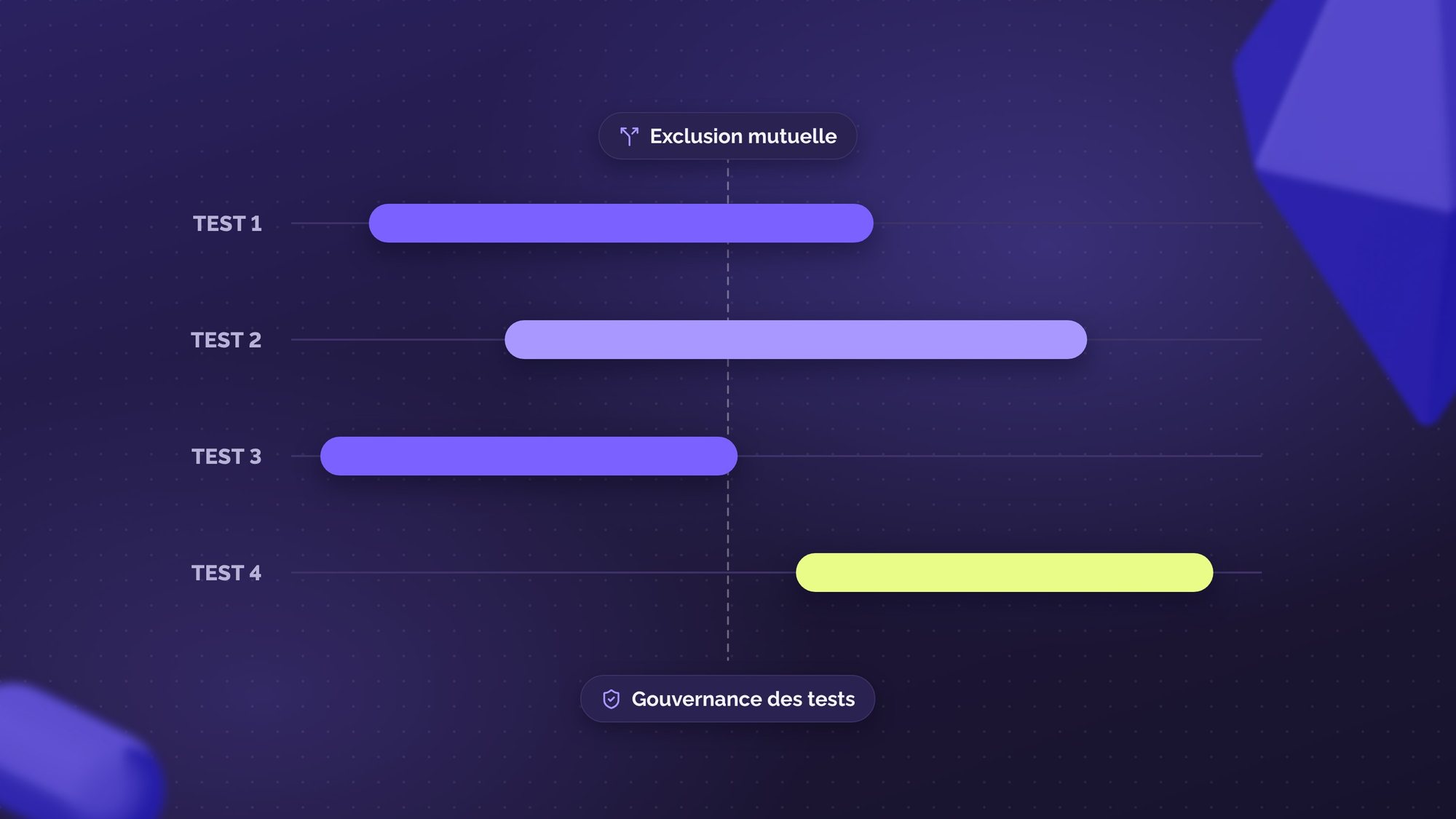
The first reflex for parallelizing safely is simple and requires no sophisticated tool: manually separate your tests by scope and by element, exactly as you would organize a product roadmap with swimlanes. Each lane represents a distinct scope, allowing minimal interaction without sacrificing velocity. During their journey, a user may move from one lane to another and therefore from one test to another. And as we've seen, that's not a problem: what matters is making sure you don't fall into one of the rare cases where one test skews the interpretation of another's results.

Figure 3: A roadmap with distinct layers between pages and elements to frame parallelization
At Welyft, we often recommend starting by modeling a first level of lanes based on page or screen templates, to distinguish the stages of the journey that each have their own stakes. If velocity requires it, a second level can then be added based on a more flexible breakdown: by element, by type of change (UI, algorithmic, pricing, etc.), or by user segment. As long as two experiments don't touch the same scope, they can run in parallel without risk of interference.
This logic works as long as your tests target distinct elements. If, on the other hand, you want to measure the interactions between several elements on the same page, you can use a multivariate test (MVT). Simply indicate this in your roadmap by having the same test appear across several lanes simultaneously.
On an e-commerce platform, this means concretely: a user can simultaneously take part in a test on the wording of the shipping step, a test on the recommendation engine, and an MVT measuring interactions between the add-to-cart CTA, the position of reviews, and the product image layout on the product page, all without any collision, because each experiment is assigned to its own lane in the roadmap.
The swimlane logic rests on an implicit assumption: what you do with one user doesn't affect others. On a marketplace (ride-hailing, food delivery, service platforms), this assumption breaks down, because supply is shared. If a test increases orders on the demand side, those orders take up drivers who would have served the control group: the two groups interact and the observed result overestimates the real effect. On top of interactions between tests, there is therefore a second family of interactions, between types of users, which swimlanes don't cover. To manage it, dedicated techniques must be built into the roadmap from the start, such as cluster randomization (isolating by geographic area) or switchback testing (alternating treatments over time).
Automation as a safety net
This manual organization is enough for the vast majority of programs. But when the volume of tests explodes, human error becomes the main threat, and that's where automation comes in.
The first level of automation, accessible to all teams, consists of running automatic checks on active tests: daily jobs evaluate every pair of ongoing tests and flag significant interactions. The rare 1-in-50,000 case gets detected; everything else runs freely. The approach is clear: parallelize by default, monitor continuously, isolate only when the data demands it.
For very high-volume programs, a second level is possible: formalizing the very architecture of the roadmap with technical mechanisms (distinct hash-salts per layer, independent user assignment), which guarantees isolation by design. But for the vast majority of teams, this level of investment isn't justified; organizing the roadmap well into swimlanes is enough to capture most of the velocity gains.
3. Why technique isn't enough
Everything we've just covered, swimlanes, MVT, automation, is technically accessible. And yet, very few organizations actually achieve it. Why? Because the real bottleneck is never the tool. It's everything that has to exist around it.
The real problem is organizational
When several teams can launch tests in parallel, someone needs to own the rules of the game. Who can test what, on which layer? What counts as a valid KPI? When is a test mature enough to be concluded? Who arbitrates when two tests target the same segment? Automation applies rules, it doesn't write them. Without clear governance, parallelization creates confusion, not value.
Trust as the driver of change
And even with clear rules, a more insidious obstacle remains: getting those rules accepted. Senior decision-makers who built their instinct on isolated results will often reject conclusions drawn from parallelized tests, especially unfavorable conclusions, out of reflex rather than analysis. "These results aren't reliable, there were other tests running" becomes a convenient argument for dismissing inconvenient data.
This is precisely what governance must deliver: building institutional trust in the methodological framework is just as important as building the framework itself. This requires education, reproducible results, and total transparency on methodology — not yet another slide deck at the executive committee meeting.
The importance of dedicated expertise
Owning governance and building this trust is a job in its own right. Organizations that scale their parallel experimentation programs all share a common trait: a dedicated function that owns the methodology, the governance rules, and the upskilling of teams. At Google or Netflix, this means an army of in-house specialists — a luxury that is neither realistic nor economically rational for most French and European companies.
Welyft structures and accelerates its clients' programs to deliver maximum learnings without ever compromising the reliability of results, from test architecture to program governance, all the way to decision-maker training.
Take action
Running A/B tests in parallel is not a reckless bet reserved for tech giants with millions of daily users. It's the operational standard for any serious digital team pursuing growth.
The real challenge is not statistical; the Microsoft study and the practices of the largest experimenters prove it. It's organizational. Teams that limit themselves out of fear of interactions don't fail because those fears came true. They fail because no one owned governance and no one had built the trust needed to act on results that don't 'feel' clean.
This is exactly the kind of statistical, technical, and organizational challenge that Welyft supports French and European digital teams with every day. From experimentation architecture to program governance, including decision-maker training, our approach is designed for the realities of your market, GDPR included.
Want to dig deeper before getting started? We've compiled a comprehensive review of the statistical frameworks, architectures, and practices of the world's best experimentation teams — a practical guide to structuring your own approach.